GST on a New Home in Edmonton: How It Changes Your Mortgage and Closing Funds

General Travis Bannert 21 Oct

Yes — GST applies to new homes in Edmonton, and it can change how much cash you need at closing. In Alberta, GST is 5% on a newly built home, and Alberta has no provincial sales tax on top of it, so the 5% is the full tax line. Resale homes are generally exempt, which is why buyers moving from resale shopping to a builder showroom are often caught off guard. See new-build approvals: rate holds, deposits and long possessions.

The mortgage risk is a mismatch: if your approval was built around a price that did not include the full GST, the shortfall can be due in cash at closing. Confirm how your contract and approval were structured well before possession day. Also see when the rate hold expires before a long build finishes.

Is GST charged on new homes in Alberta?

Yes. A newly constructed home — and most substantially renovated homes — is a taxable supply, so 5% GST is charged on the price. A lived-in resale home is generally exempt. From the buyer’s side, see GST on new homes in Alberta: when it applies, from the buyer’s side.

That 5% is not a rounding error. Illustration only: on a $500,000 new home, 5% GST equals $25,000. That is arithmetic, not a quote — but it shows why this line item can matter more to your closing funds than most builder upgrades. See closing costs beyond the down payment, GST included.

Is the builder’s price “plus GST” or “GST in”?

Ask this question before you sign, in those exact words. Builder prices are sometimes quoted net of GST and net of expected rebates, which makes the show-home number look lower than the amount the contract actually settles at.

Get the answer in writing: base price, GST amount, any rebate the price assumes, and the total you will owe. If the price was quoted net of a rebate you do not qualify for, that difference also lands on you at closing.

“She got everything done fast and found me a great rate too. Honestly, I felt really taken care of the whole time.” — Vince, Google review

New home GST and closing funds in Edmonton — downtown Edmonton skyline

Can GST be added to your mortgage?

Not always in the simple way buyers assume. Whether GST forms part of the amount your mortgage is approved on depends on how the contract and the approval were structured — and that varies by file.

The practical point: do not assume. Confirm with your broker and lawyer, line by line, whether your approval and funds-to-close include the full GST. If they do not, the gap is cash at closing. A review through my Pre-Approval & Refinance Check catches this mismatch early.

What rebates can reduce the GST?

Two programs matter, and they are different:

  • The longstanding GST New Housing Rebate: you can recover 36% of the GST, to a maximum of $6,300. The full rebate applies at $350,000 or less, phases out to $450,000, and is zero above that. Sometimes the builder credits it at closing and sometimes you claim it yourself — confirm which applies.
  • Newer federal GST relief for first-time buyers: announced relief of up to 100% of the GST on new homes up to $1 million for eligible first-time buyers, phasing out toward $1.5 million. Eligibility is date-specific and depends on when your agreement was signed — do not count on it until your lawyer or the CRA confirms your contract qualifies.

What should you confirm before you sign with a builder?

Four things: whether the price is plus GST or GST included; whether any rebate is netted into the price; whether your approval reflects the full GST-inclusive figure; and your total funds-to-close, in writing. If other financing is renewing around the purchase, a Mortgage Renewal Check keeps the picture in one place.

Building or buying new in Edmonton? Call me before you sign and we will run the GST line, the rebates, and your closing funds on your actual contract — not the show-home price. Call (780) 722-5621.

By Travis Bannert, Realtor and Mortgage Broker

Travis Bannert, Mortgage Broker | Next Door Mortgages, Dominion Lending Centres | (780) 722-5621 | nextdoormortgages.com


GST on a New Home in Canada: What Buyers Owe and How It Affects the Mortgage

General Travis Bannert 21 Oct

GST on a new home in Canada is 5% of the purchase price, charged on newly built homes and substantial renovations — and it is usually payable in cash at closing rather than rolled into the mortgage. That last point catches buyers off guard: most plan their down payment down to the dollar, then discover a five-figure tax bill due on possession day. Plan for it from the first budget, not the final week.

New home GST and closing funds in Edmonton — Walterdale Bridge
Photo: Crisco 1492, via Wikimedia Commons (CC BY-SA 4.0).

Which homes actually have GST charged on them?

GST applies to new housing: a newly constructed home, and in some cases a home that has been substantially renovated. Resale homes are generally exempt — no GST when you buy a used home from its owner.

In Alberta there is no provincial sales tax stacked on top, so the federal 5% GST is the full sales-tax picture on a new build here. That is one reason the Alberta new-home math looks different from provinces where a provincial tax is added as well.

Substantial renovation is a technical term with a threshold most casual updates never reach, but if you are buying a comprehensively rebuilt property, confirm its tax status in writing before you rely on it.

Can the GST be added to the mortgage?

Usually not. Lenders and insurers typically require GST on a new home to be paid from the buyer’s own funds at closing, separate from the mortgage advance. Confirm the treatment on your specific file early, because it changes how much cash you truly need.

That is the real planning point: your funds to close are the down payment, plus GST where it applies, plus your other closing costs. A pre-approval that only counts the down payment can leave you short on possession day even when the mortgage itself is approved.

It is also why new-build purchases are planned on two timelines at once. My guide to New-Build Mortgage Approvals covers the approval side, and a Pre-Approval & Refinance Check is where the full cash-to-close number gets worked out before you sign with a builder.

“We always refer our own clients, family and friends to Travis and his team without hesitation.” – Funk Law, Google review

Is there any relief from GST for first-time buyers?

A federal GST relief measure for first-time buyers of new homes was announced in 2025: up to the full GST on a new home priced up to $1 million, phasing out toward $1.5 million. Relief measures like this depend on legislation and program rules that are confirmed at the time you buy, so verify the current status before building it into a budget — never assume it has landed.

Separately, a long-standing GST New Housing Rebate has existed for qualifying new homes within specific price ranges, with its own forms and conditions. Whether either relief route applies to you is a question for your lawyer or tax advisor at the time of purchase.

What I can do as your broker is make sure the mortgage plan does not silently assume money you have not confirmed. If a rebate is coming, we plan for when it arrives — not before.

Is the builder’s price “plus GST” or “GST included”?

Ask this question before you sign, in those exact words. Builder prices are sometimes quoted net of GST, so the 5% lands on top of the number you budgeted around.

Get the answer in writing: the base price, the GST amount, any rebate the price assumes, and the total you will actually pay. Illustration only: on a $500,000 new home, 5% GST equals $25,000. That is arithmetic, not a quote — but it shows why the GST line deserves its own budget.

On rebates, the reference numbers: the long-standing GST New Housing Rebate lets buyers recover 36% of the GST, to a maximum of $6,300, with the full rebate applying at $350,000 or less. The newer federal GST relief for first-time buyers covers up to 100% of the GST on new homes up to $1 million for eligible buyers.

Buying new and want the full cash-to-close picture before you sign? Call me at (780) 722-5621 — I will try to call you this week, and if you reply with a good time, we can map your down payment, GST and closing costs on one page.

By Travis Bannert, Realtor and Mortgage Broker
Travis Bannert, Mortgage Broker | Next Door Mortgages, Dominion Lending Centres | (780) 722-5621 | nextdoormortgages.com
Mortgage Stress Test Explained: The Qualifying Rate and Your Edmonton Budget

General Travis Bannert 21 Oct

Under Canada’s mortgage stress test, you don’t qualify at the rate you’ll actually pay — you qualify at the higher of your contract rate plus 2%, or the federal benchmark rate of 5.25%. The test doesn’t change your real payment; it caps how much a federally regulated lender can approve you for, and on a typical Edmonton purchase it reduces the maximum mortgage by roughly 15–20% compared with qualifying at the contract rate alone.

How does the stress test calculation work?

Take your contract rate, add 2 percentage points, and compare it with 5.25%. Your file is tested at whichever is higher. Your income then has to carry the mortgage at that qualifying rate inside the standard debt-ratio limits (housing costs within the gross debt service ratio, and total debts within the total debt service ratio) that lenders and insurers apply.

A worked example with round numbers — an illustration, not a rate quote:

  • Example contract rate: 4.50% → qualifying rate: 6.50% (4.50% + 2%, which is higher than the 5.25% benchmark)
  • A $400,000 mortgage over 25 years at 4.50% costs about $2,223/month
  • The same payment room tested at 6.50% supports only about $329,000 of mortgage

That’s the whole effect in one line: at a qualifying rate 2 points higher, the same income supports roughly $70,000 less mortgage on a $400,000 example. Your actual numbers move with your real rate, income, debts, property taxes, and heating costs — which is why a proper Pre-Approval & Refinance Check uses your file, not a generic calculator. See the affordability worksheet: running the ratios on your numbers.

Who does the stress test apply to?

  • Insured mortgages (less than 20% down): yes — the test is built into the mortgage insurer’s rules.
  • Uninsured mortgages (20%+ down) at banks and other federally regulated lenders: yes, under the federal B-20 rules.
  • Renewals: if you simply renew with your current lender, you’re generally not re-tested; switching lenders at renewal usually means qualifying again under the rules that apply to a new application. If a renewal is coming up, check your position with a Mortgage Renewal Check before assuming you can move.
  • Some provincially regulated lenders (such as credit unions) may not be required to apply the federal test the same way — one of several reasons broker access to multiple lender types matters on tight files.

Edmonton mortgage budget — Walterdale Bridge into downtown

Does the stress test change what you actually pay?

No. Your payment is always based on your real contract rate. The test is an underwriting cushion: it checks that you could still carry the mortgage if rates were higher at renewal. It’s also why two buyers with the same income can be approved for very different amounts at different times — when contract rates rise, contract-plus-2% rises with them, and maximum approvals fall even before any lender says no.

“Great rates, fast closing, and excellent customer service.” — Madhav Dhakal, Google review

How can Edmonton buyers work with the stress test instead of against it?

Three levers actually move your tested budget: paying down other debts before applying (car payments are the usual culprit), increasing the down payment, and choosing the amortization and property costs (taxes, condo fees, heat) that the ratios actually count. Guessing helps none of them. First-time buyers can see how the test fits into the full buying sequence in my First Home Guide for Edmonton. See how much down payment changes the qualifying picture.

Want your real tested number — not a calculator’s guess? Call me and I’ll run your file through the stress test properly, and show you which lever would raise your budget the most before you start shopping. See how long your pre-approval — and its qualifying rate — lasts.

By Travis Bannert, Realtor and Mortgage Broker

Travis Bannert, Mortgage Broker | Next Door Mortgages, Dominion Lending Centres | (780) 722-5621 | nextdoormortgages.com

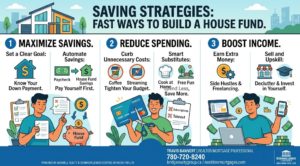
Saving Strategies: Fast Ways to Build Your House Fund

Down Payments & Affordability Travis Bannert 18 Aug

Saving for a down payment is often the biggest hurdle on the path to homeownership. With a clear strategy, disciplined habits, and smart financial moves, you can accelerate your timeline and turn your homeownership dreams into reality faster than you think.

1. Maximize Your Savings
Set a Concrete Down Payment Target: Calculate exactly how much you need based on target home prices and loan options. Having a precise dollar figure keeps your efforts focused.

Pay Yourself First: Automate transfers directly from each paycheck into a dedicated, high-interest house fund before spending on daily expenses.

2. Optimize Spending & Trim Waste
Audit Recurring Expenses: Review monthly subscriptions, dining-out habits, and impulse purchases. Small daily trims compound quickly into significant monthly savings.

Choose Smart Substitutes: Cook meals at home and explore free local entertainment options rather than costly weekend outings.

3. Boost Your Inflow
Monetize Skills & Spare Time: Take on freelance work, pick up side hustles, or declutter your home by selling unused items.

Direct Windfalls to the Goal: Allocate tax refunds, bonuses, or cash gifts entirely to your down payment account.

Ready to Make Your Move?

Whether you are looking to understand how much home you can afford, explore loan options, or get pre-approved, expert guidance makes all the difference.

Contact Travis Bannert | Realtor / Mortgage Professional

Phone: 780-720-8240

Web: bridgerealtygroup.ca | nextdoormortgages.com

Dominion Lending Centres Brokers for Life

12